Frequently Asked Questions (FAQ)
Here you will find answers to the most frequently asked questions about our products, deliveries, warranties and service. Click on a category below to go directly to what you are looking for – or browse further.

Here you will find answers to the most frequently asked questions about our products, deliveries, warranties and service. Click on a category below to go directly to what you are looking for – or browse further.
A complete mask weighs only 360 grams.
Through a fan that adjusts airflow based on the user's breathing pattern, extending battery life and reducing filter consumption.
TIKI is made of PET-G and TPE plastics.
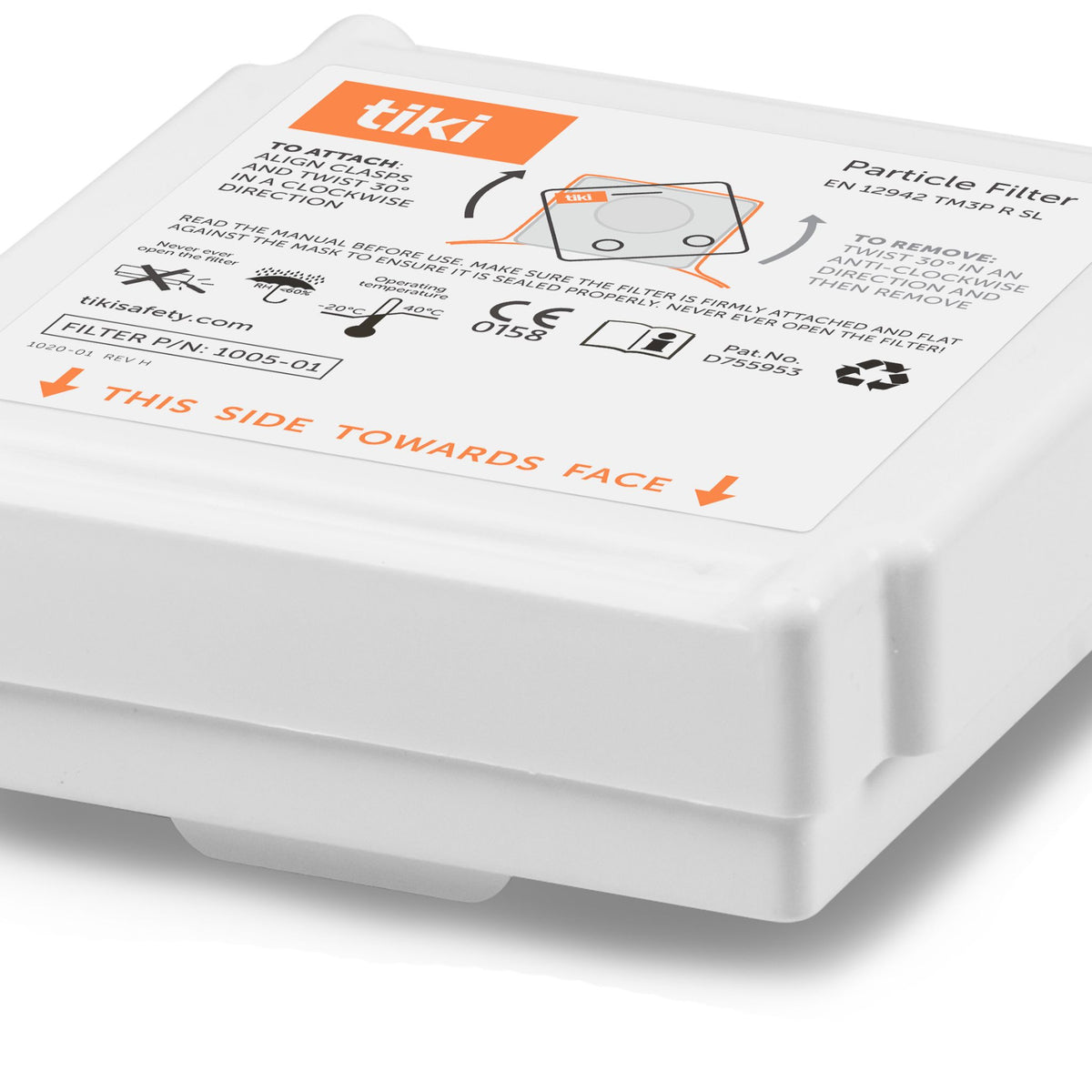
The filter protects against all types of particulate pollution (P3), such as quartz dust, asbestos and bacteria.
It depends on the usage environment. For example, a craftsman who uses the mask a few times a week may need to change the filter every 20 to 120 days, while when sandblasting it may need to be changed every two to five days.
Up to 2.5 hours with the built-in battery and up to 10 hours with the external battery (accessory).
Either with the included mains charger (220/110V) or with a 12V charger (accessory) that fits in the car's cigarette lighter socket.
TIKI has three built-in warning systems: 1) When the particle filter needs to be replaced or is clogged. 2) When the battery is low and needs to be charged. 3) If the mask is not tight or leaking.
At our facility in Upplands-Bro, outside Stockholm, Sweden.
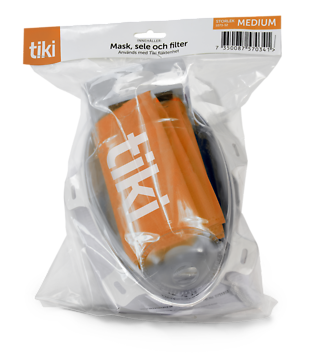
TIKI is available in three sizes – Small, Medium and Large. To find the right size, please consult TIKI's size guide.
If the fan is unusually loud, it may be because the mask is not sealing properly. Check that the mask is properly fitted and that you have the correct size.
TIKI should not be immersed in water. The TIKI is the only PAPR mask in the world that has been tested and can be used in decontamination showers.
Thanks to the superior capacity of the LiPo batteries, TIKI can be stored for a long time. Contact us for advice on how to best maintain the batteries.
You will find technical specifications in the user manual which can be downloaded from our website.
For support questions, please send an email to support@tikisafety.com.
TIKI Medical is a positive pressure mask that filters both inhaled and exhaled air, making it particularly suitable for environments with high hygiene requirements – such as healthcare, infection control units and laboratories. TIKI medical protects both the user and the environment.
TIKI Medical has protection class P3 , which provides the highest protection against both solid particles (such as dust) and liquid aerosols (such as virus-carrying droplets). It is tested according to EN 12941 class TH3 .
TIKI medical has a built-in, self-regulating fan that provides positive pressure in the mask. This makes breathing easy and comfortable – even during longer work shifts.
Yes, TIKI is ergonomically designed and very lightweight. It fits comfortably with an elastic harness and has a large visor that provides good visibility and easy communication.
It is developed for:
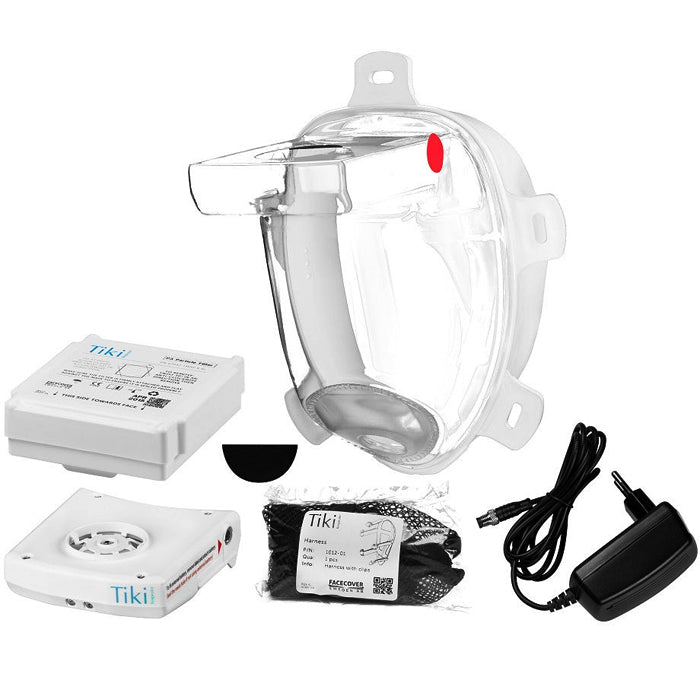
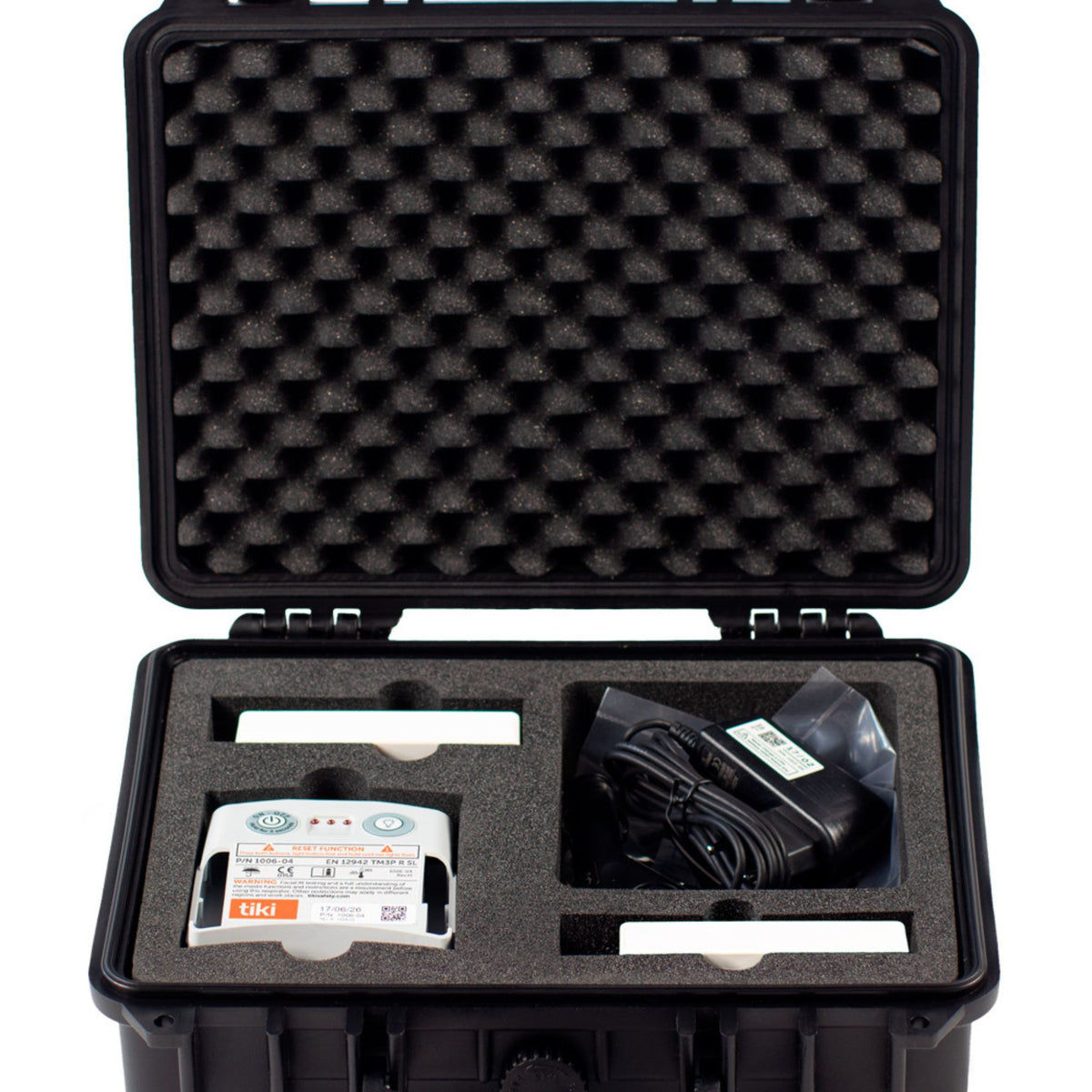
The package includes:
Yes. TIKI Medical is a sustainable alternative to disposable masks. It can be reused and stored for a long time – perfect for emergency stockpiles.
You can find size guides for Medium and Large under downloadable documents on the product page – available in Swedish, English and German.
No, all prices are shown excluding VAT . Shipping is added when ordering.
Visit our youtube channel for more detailed videos
Choosing the best PAPR (Powered Air-Purifying Respirator) isn’t about a single brand or model – it’s about finding the system that gives you the right protection level, comfort and visibility for your job.
This guide walks through what to look for in a PAPR and how TIKI’s lightweight, visor-based design fits into that picture for demanding users in construction, healthcare, laboratories and industry.
A PAPR (Powered Air-Purifying Respirator) uses a battery-powered blower to pull ambient air through filters and deliver clean, filtered air into a hood, mask or visor.
Unlike negative-pressure masks (such as N95, FFP2 or traditional half masks), PAPRs:
- Reduce
- Breathing
- Resistance
In European standards, high-performance PAPRs can be certified to EN12942 with TM3P protection, which corresponds to the highest particulate protection classes for powered respirators.TikiSafety AB
Different industries will have different “best” options, but the core evaluation points are the same:
Filter class (e.g. P3, HEPA)
Certified according to relevant standards (e.g. EN12942 TM3P in Europe)
Suitable for the type of hazard (dust, aerosols, infectious agents, etc.)
Total weight of head and neck
Breathing resistance and air flow
Noise level from fan
Heat build-up inside hood or mask
Field of vision
Fogging or condensation
Ability to communicate with colleagues and patients or customers
How quickly the system can be put on and taken off
How easy it is to clean and disinfect
Filter replacement and battery management
Compatibility with other personal protective equipment (helmets, hearing protection)
Suitability for your environment: construction dust, quartz dust, laboratory environments, healthcare, etc.
The “best PAPR respirator” is the one that scores highly across these factors for your specific tasks.
Negative-pressure respirators (e.g. N95 or FFP2 masks) rely on your lungs to pull air through the filter. That means:
Higher breathing resistance
More fatigue over time
Regulatory data on Assigned Protection Factors (APF) show that powered respirators generally offer significantly higher protection than standard filtering facepieces and even many full-face negative-pressure masks, particularly in real-world workplace conditions.
For environments with high dust levels, infectious aerosols or long exposure durations, PAPRs are often recommended as the preferred solution.
TIKI is a Scandinavian-developed PAPR system designed to solve several common problems seen in traditional powered respirators:
Instead of a heavy helmet, belt-mounted blower and hoses, TIKI integrates:
- fan unit inside the visor
- P3 filter with TM3P-level protection according to EN12942TikiSafety AB
- An elastic harness that keeps everything in place
This reduces weight, simplifies donning and increases freedom of movement.
The panoramic visor is designed to maintain clear vision and visual contact with colleagues, which is critical in:
- Construction and renovation
- Healthcare and emergency situations
- Laboratory and industrial work where hand signals and facial expressions are important
TIKI’s fan automatically adjusts airflow to maintain comfort and positive pressure inside the visor, helping to:
- Keep the breathing resistance low
- Reduce fatigue
- Maintain consistent protection under varying workloads
With its P3 filter and EN12942 TM3P certification, TIKI is designed for tasks involving:
- Quartz dust, construction and stone dust
- Industrial dust and aerosols
- Airborne infectious particles in healthcare and laboratories
Rather than claiming to be “the single best PAPR respirator for everyone”, TIKI is built as a high-performance alternative for professionals who value:
- Maximum mobility
- High visibility
- Real comfort during long shifts
A PAPR system may be the best respirator choice if you:
- Working daily in a dusty or contaminated air (quartz dust, construction, sanding, grinding)
- Need extended wear time without excessive fatigue
- Demands a clear view of your surroundings and team
- Do you want a reusable, sustainable solution instead of constant disposable mask use
If these points describe your workplace, a modern PAPR such as TIKI is often a better long-term solution than traditional disposable or half-mask respirators.
Within the TIKI range, you can choose a PAPR configuration that matches your field:
– TIKI START the core system for demanding dust and particle environments
- TIKI Pro/Multi/Medical – specialised versions tailored towards industry, multi-use settings and medical environments
- Filter and visor package – for ongoing use and replacement cycles
Each system shares the same core principles: powered filtration, high protection level, low breathing resistance and excellent visibility.